
The Virgin Birth of Christ
Matthew 1:18-25P. G. Mathew | Sunday, December 22, 1996
Copyright © 1996, P. G. Mathew
This year the best Christmas gift a parent can give a child is a toy Elmo doll. I hope you all have bought a sufficient number of them, because if you have not, they say you cannot be considered good parents and therefore must feel guilty. That, at least, is the opinion of the world.
The gift the heavenly Father is giving the world during this season is the unspeakable gift of a Savior, Jesus, the eternal Son of God. The question is, have you received him? And, additionally, have you proclaimed him to your children that they may also put their trust in Jesus Christ as their Savior?
This Savior, Jesus Christ, was conceived of the Holy Spirit and born of the virgin Mary as the Lord had promised over seven hundred years earlier through the prophet Isaiah. During this season the true church celebrates the birth of this virgin-born child who is born to us, the son who is given to us, the Mighty God, the Son of David, the everlasting King, the shoot out of the stump of Jesse, as well as the root of Jesse, the liberator of all burdens.
The Gospel Introductions
How do the gospels introduce this Jesus to us? In their narratives Matthew and Luke call him virgin-born Savior, the Lord Christ Jesus, the Holy One, the Son of the Most High, the Son of God, and Immanuel. Mark does not give us an account of his birth as Matthew and Luke do, but he does introduce him as Jesus Christ the Son of God.
What about John? In his prologue in the first chapter, John introduces Jesus Christ to us, first saying, “In the beginning was the Word . . .” J. I. Packer tells us in his book Knowing God that in this verse we are told of the eternity of the Lord Jesus Christ. When other things began, he was. He was from all eternity and he is from all eternity. Jesus Christ is eternal.
Verse 1 continues, “and the Word was with God. . .” That speaks about his personality. This Word is a personal being, an eternal personality, distinct from the Father and yet eternally in fellowship with God the Father. Then John says, “and the Word was God.” That speaks about the deity of this Word. He is God and yet he is personally distinct from the Father.
In verse 3 we read, “Through him all things were made; without him nothing was made that has been made.” John is telling us the Word is the Creator of all things, visible and invisible. He created all for the Father yet was not part of creation. Then we are told in verse 4, “In him was life.” By this John tells us the origin of all life–angelic, human, animal, vegetable–must be seen in Jesus Christ. Additionally, it tells us the cause of the continuation of this life must also be seen in this Word who is God, Jesus Christ.
Verse 4 says, “In him was life, and that life was the light of men.” Not only is Jesus the author of all life, but he also is the author of revelation. The knowledge of God comes to us only through Jesus Christ. There is no other way anyone can know God except through the Word, God, Jesus Christ.
In verse 14 we are told, “The Word became flesh and made his dwelling among us.” John understands that Jesus Christ is the eternal Word, the personal being distinct from the Father, God himself, the creator and author of all life and the author of all revelation of God. This God, this Creator, this Word became flesh. Mighty God lay helplessly as a baby in a cattle feeding trough. But John has no doubt as to who this one is. In verse 14 he continues, “We have seen his glory, the glory of the One and Only, the only Begotten, who came from the Father, full of grace and truth.” And finally, in verse 18, John writes, “No one has ever seen God but God the One and Only, who is at the Father’s side, has made him known.” Thus John introduces Jesus Christ to us. God became flesh.
A Crude Fact?
Some people, such as Professor William Barclay, a great Scottish scholar, and others, who look upon the birth of Jesus Christ as a crude fact. They do not see any beauty in this virgin birth. In his study on Matthew, Barclay tells us that the virgin birth is a doctrine which presents us with many difficulties. “And our church” he was speaking about his church, “does not compel us to accept it in the literal and the physical sense.” Isn’t that wonderful? We have come a long way. The creeds all stated that the virgin birth of Jesus Christ is an essential part of Christian faith, but Barclay said his church would not compel him or anyone else to believe and accept the virgin birth of Jesus Christ in a literal, physical sense, although, as a scholar, Barclay knew that the Bible teaches a literal, physical virgin birth.
Thus, Barclay says this is one of the doctrines on which the church gives us full liberty to come to our own conclusion. He and his friends are telling us we do not have to believe what the Bible clearly teaches because we are living in the modern scientific age and should no longer believe in the primitive conception of miracles.
But to me and to this church and to millions of orthodox, Bible-believing Christians around the world, the virgin birth of Jesus is not a crude fact. To us who believe in God as the creator of the heavens and the earth, believing in miracles is not at all a problem. We glory in the virgin birth of Jesus, the second person of the Godhead, because without the virgin birth, the cross will be emptied of its power. Without the virgin birth, Jesus would be just a man, not be able to save anyone. He himself would need a savior. If we remove the virgin birth, then we remove the power of the cross to save us.
Matthew’s Account
The accounts of the birth of Jesus Christ as found in the gospels of Matthew and Luke are quite detailed, and when we examine them, we notice that they are totally independent of each other. Yet they concur in this great doctrine of the virgin birth.
First, in Matthew’s account, Matthew tells us that Joseph had nothing to do with the begetting of Jesus. Matthew 1:16 says, “and Jacob the father of Joseph, the husband of Mary, of whom was born Jesus who is called Christ.” He explains this in verse 18, “This is how the birth of Jesus Christ came about: His mother Mary was pledged to be married to Joseph. But before they came together, she was found to be with child” ek pneumatos hagiou , “through the Holy Spirit.” And in verse 20 you read that the angel was commissioned to come to Joseph at night in a dream. Contrary to what Joseph had thought, the angel tells him again about the supernatural aspect of this pregnancy: “Joseph, son of David, do not be afraid to take Mary home as your wife because what is conceived in her is,” again, ek pneumatos hagiou , “of the Holy Spirit.”
In verse 23 Matthew continues, “All this took place so that the word of the Lord might be fulfilled.” What was that word? “The virgin will be with child and will give birth to a son, and they will call him Immanuel–which means ‘God with us.'” I agree with James Orr and J. Gresham Machen and a number of others that the prophecy of Isaiah 7:14 has a singular reference. This prophecy is speaking about the birth of Jesus Christ through the virgin Mary by the power of the Holy Spirit.
Thus Matthew, under the inspiration of the same Holy Spirit who inspired Isaiah to write his prophecy, says that this took place in fulfillment of what the Lord spoke through Isaiah. Jesus was born of a virgin. In verse 25 Matthew goes out of his way to let us know that Joseph did not have any sexual relationship with Mary until this son was born. And finally in verse 25 it says “He [Joseph] gave him the name Jesus.” Giving Jesus his name meant that Joseph was adopting Jesus as his son and becoming his legal father. Joseph is addressed here as the son of David, which means that he is a prince, although the Davidic dynasty had declined and was in an eclipse. But now we see that out of the stump of Jesse’s line came a shoot, a branch, who is Jesus. He became the legal heir to that throne through Joseph, the son of David, and through Joseph’s adoption of him.
Luke’s Account of the Virgin Birth
Luke also gives us clear evidence of his belief in the virgin birth of Christ. In Luke 1:27 we are told that Mary is called a virgin, he parthenos . Luke uses the word twice in that verse. And in Luke 1:34, this young girl, this virgin Mary, asks, “How can this be since I do not know a man?” meaning to know a man sexually. And the angel’s answer is that the Holy Spirit would come upon her. “The power of the Most High shall overshadow you.” Then Gabriel added that there is nothing impossible with God.
Was Luke making this up? We must remember that he was a historian who was interested only in the truth. In Luke 1 we read, “Many have undertaken to draw up an account of the things that have been fulfilled among us. . . ” Luke was not setting out to write a mythology or a collection of legends. He was a historian whose purpose was to write “the things that took place among us, just as they were handed down to us by those who from the first were eyewitnesses.” There is no question that the source for Matthew and Luke for this account of the virgin birth was Mary herself, the mother of Jesus. Luke interviewed “eyewitnesses and servants of the word”–those who saw the events he was recording.
Not only that, Luke also states, “Therefore, since I myself have carefully investigated everything from the beginning. . .” His intent was not to sit down and write a novel, creating everything out of his own head. He was a historian who personally investigated all things about Jesus Christ “from the beginning,” which included the virgin birth. And because of his investigations, he says to his readers, “it seemed good also to me to write an orderly account.” Why? “So that you may know the certainty of the things you have been taught.” Luke wanted his readers to know that what they have been taught was true, certain, factual.
Thus Luke began his gospel account first by the narration of the supernatural birth of John the Baptist and second with the supernatural virgin birth of Jesus Christ. We must understand this is something historical, factual, seen by eyewitnesses, and investigated carefully. It is recorded that we may have certainty of the gospel.
The church of Jesus Christ has always believed in the virgin birth, as revealed by its creeds. This doctrine is essential to our salvation. So unlike William Barclay and his church, our church believes, teaches, and glories in the biblical doctrine of the virgin birth of Jesus. If we deny the virgin birth, we will soon begin to deny all the miracles of the Bible. We will reduce Jesus to being a mere man, albeit a nice, ethical one. In fact, we may even say he is the best man, but still a man, incapable of saving anyone. What does such reductionism do? It removes the joy of Christmas by removing the Savior.
Joseph Makes a Decision
Luke’s detailed account of the birth of Jesus Christ gives clear evidence of his belief in the virgin birth. After the angelic announcement to Mary in Nazareth, she was overshadowed by the Holy Spirit and she conceived. Mary then went from Nazareth to Judea to visit Elizabeth and receive spiritual encouragement and fellowship from her. After three months, Mary returned to Nazareth and Joseph learned of Mary’s pregnancy. In my view Mary did not give Joseph any explanation for her state, and thus he found himself facing a grave decision.
In Jewish circles of that time marriage consisted of, first, a betrothal in which the couple exchanged vows of fidelity before witnesses. From that point on the man was known as husband and the woman was known as wife. This was the first phase of marriage. But before the couple lived together as husband and wife, however, there was a space of about one year. At the end of the one year period, the husband would come and ceremoniously take his bride to his home in a celebration such as we read about in Matthew 25. After the marriage feast, the couple would live together as husband and wife.
Mary became pregnant before she lived with Joseph and before any sexual relations took place. But in Deuteronomy 22 there were very clear instructions for dealing with a person who became pregnant outside of marriage. Deuteronomy 22, beginning with verse 23, says “If a man happens to meet in a town a virgin pledged to be married and he sleeps with her, you shall take both of them to the gate of that town and stone them to death,” and so on. Whether they practiced this during the New Testament times or not, we do not know, but that was the punishment stipulated by the Old Testament.
Mary informed Joseph that she was pregnant. Being a just man like Job and Zechariah, Joseph refused to marry her. At the same time, though, he desired to divorce her privately by writing her a bill of divorcement in front of two witnesses and letting her go as permitted in Deuteronomy 24:1.
What was Mary doing during this time? Again, I do not think Mary explained anything to Joseph at all, but she trusted in the Lord with regard to this issue. In my view, she probably reasoned, “Nothing is impossible with God, and as Gabriel stated, I am pregnant with the holy Child by the supernatural work and power of the Holy Spirit. Additionally, I know that the barren Elizabeth of Judea is about to deliver John as Gabriel had also foretold. In fact, I myself went and saw that everything was just as the angel had said.” So Mary probably came to this conclusion: “This problem with Joseph is God’s problem. He must solve it, and he will solve it. I must trust God.”
The Decision of God
Sure enough, God sent an angel to Joseph. I am sure Joseph loved Mary and yet he could not go ahead with this marriage. After deciding to divorce her privately, he went to bed. I am also sure that before Joseph went to bed, he prayed. He probably said, “O God, take care of this matter,” because he was a believer and a just man.
The angel of the Lord spoke to Joseph in a dream that night and brought a command from the Lord, which we read in Matthew 1:20-21. What was it? First, the angel told Joseph, “Do not fear to take Mary as your wife.” God wanted him to go ahead with the second part of his marriage. He wanted him to bring Mary ceremoniously to his house, have a marriage feast and to begin to live with her. And then God revealed the truth to Joseph about Mary. The angel continued, “because what is conceived in her is from the Holy Spirit.” When Joseph heard these words, the darkness was dispelled from his mind and heart. Why? The angel was saying that Mary was not an adulteress. She was a virgin–innocent, just, righteous, and pure. In other words, this pregnancy was God’s work. Joseph did love Mary, so you can imagine the joy that filled his soul as he heard these words.
Then the angel gave further instructions, “She will give birth to a son, and you are to give him the name Jesus.” In other words, Joseph must protect Mary, honor her and provide for her. He must adopt this son by naming him, which was an official act. Thus Joseph would become the legal father of Jesus. As I said, Joseph was the prince, the son of David, the legal heir to the throne. Now, by being named and adopted by Joseph, Jesus became the legal heir to the throne of David. He is Jesus the king.
Notice how Joseph went to bed with one decision and woke up with God’s decision. How many times do we decide without facts or understanding? I may tell people, “Go and pray,” and often they come back and say, “I prayed,” but I do not know what they really did. Prayer means going to God and saying, “God, show me your way, your decision. I have already decided but it doesn’t have to be right. What is your decision?” It may surprise you to discover that sometimes God’s decision is exactly opposite to the decision we have made.
Joseph accepted God’s guidance and changed his previous decision to divorce Mary. He took her for his wife, protected her, provided for her, and honored her. And when she gave birth, he dutifully adopted her son and gave him the name Jesus.
The Purpose of the Virgin Birth
Who is this Jesus? The angel told Joseph “you are to give him the name Jesus. . .” Why? “because he will save his people from their sins” (v. 21). The Greek text tells us that he himself, he alone, will do it, meaning there is no other savior. Jesus alone shall save his people. Here, then, is revealed the purpose of this virgin birth. What is the purpose? To give us a Savior who is capable of saving his people from their sins.
In Psalm 49:7, 8 we read, “No man can redeem the life of another or give to God a ransom for him–the ransom for a life is costly, no payment is ever enough. . .” And verse 15, “But God will redeem my life from the grave, he will surely take me to himself.” And in Psalm 130:7, 8 we find another reference to what is reflected in Matthew 1: “O Israel, put your hope in the Lord, for with the Lord is unfailing love and with him is full redemption. He himself will redeem Israel from all their sins.” In the fullness of time God, through the virgin birth, is giving us a Savior who is God/man, able to redeem us from our sins. Joseph was told to name him Jesus, for he alone would save his people from their sins.
Now Jesus was a common name during New Testament times and anyone could name his child Jesus. The name Jesus is taken from the Hebrew verb yasha , which means to save and deliver people from danger, sickness, and death. But the problem is, can any person save another from these problems? And who can deliver us from the greatest problem of man, which is sin?
Man’s Fundamental Problem
In Acts 4:12 Peter says there is no other Savior than Jesus Christ. What does he save people from? Their sins. Let me assure you, the fundamental problem of man is not political, economic, social, medical, or educational. The fundamental problem of man is sin. It is the cause of all human sufferings and all other problems.
In Genesis 3 we see how sin came into humanity. Adam sinned, and through him we all are sinners. The human heart is the problem. In Jeremiah 17:9 we read that our hearts are deceitful above all things and desperately wicked, and in Romans 3 we read that no one seeks God and all have turned astray. There is no fear of God in man.
Jesus also spoke about the human heart. “For out of the heart come evil thoughts, murder, adultery, sexual immorality, theft, false testimony, slander” (Matt. 15:19). In the depths of his heart, man is an enemy of God and cut off from the life of God. Sin has separated man from God, and Jesus came to solve the sin problem and reconcile us to God through the cross.
We must recognize that Jesus alone is perfect God and perfect, sinless man, and, as such, only Jesus can give his life a ransom for many (Matt. 20:28). In Matthew 26:28, while instituting the holy supper, Jesus said, “This is my blood of the covenant, which is poured out for many for the forgiveness of sins.” There is no other way to save people from their sins except the sinless God/man coming into the world and dying on the cross. In 2 Corinthians 5:21 Paul wrote, “God made him who had no sin to be sin for us, so that in him we might become the righteousness of God.” And in 1 Corinthians 15:3 he simply wrote, “Christ died for our sins.”
I want you to know that the one who lay helplessly in the cattle trough in Bethlehem is the almighty God become flesh. He died on the cross for sinners that he may redeem his people, Jews and Gentiles, from their sins. The covenant with Abraham is that in his offspring all the families of the earth be blessed, and just as Christ loved the church and gave himself for his elect people, the elect people of God will surely repent, believe on the Lord Jesus Christ, and be saved. Jesus Christ will save all his people.
The Fullness of Salvation
What does salvation mean? First, it means salvation from sin–from the guilt of sin, the power of sin, the punishment of sin, and the presence of sin. The problem is sin, and it is dealt with totally and comprehensively by Jesus Christ.
Not only that, we are saved to God unto life eternal. What is the purpose of salvation? That we may have fellowship with God and his Son Jesus Christ our Lord, as we read in John 17:3, “Now this is eternal life: that they may know you, the only true God, and Jesus Christ, whom thou hast sent.” The virgin-born Jesus Christ, who obeyed God fully, died on the cross in behalf of our sins and gave us eternal life. This is God’s way of saving.
In contrast to that, there are men’s ways of saving themselves. A French psychotherapist claimed that he solved the problem of man by autosuggestion. (PGM) He said it was very simple. One needed only to get up in the morning and chant this mantra: “Day by day, in every way, I am getting better and better,” and there would be no problems. Today’s New Age leaders like Shirley MacLaine use another mantra to solve the human problem: “I am God and I can create my own reality.” All New Ageism teaches this lie that man is God. But the problem is, all human diagnosis of the human problem is false, and thus all human solutions are false.
God looked at man and saw his problem, which is sin, and sent a Savior, his only Son, to solve the sin problem and to bring us back into joyful fellowship with him. Thus, God says to us, “I know your problem. It is your heart. You are a rebel who is cut off from God. The solution to your problem is through my Son, the Savior, King Jesus. Through his death he will solve the sin problem and reconcile you to me.” And that is what Jesus Christ did. The good shepherd laid down his life for the sheep.
Let me tell you, any efforts of self-redemption by a sinner are utter foolishness and impossibility. God gave us a Savior from heaven. Paul says Jesus is the second man from heaven, and Matthew tells us he is Immanuel, the with-us God.
Receiving God’s Gift
I must ask you two extremely serious questions. First, have you received this personal gift of the Father? Second, have you given this gift to your children? These are serious questions. Why? This one is Immanuel, God with us. Jesus said, “Surely I am with you always, to the very end of the age” (Matt. 28:20).
Truly to us a child is born, a son is given–for our salvation and for our joy! The Word became flesh, meaning God the Creator, the eternal Son of God, became flesh and dwelt among us. He came to dwell “with the sick,” William Hendriksen says, “to heal them.” He came to dwell “with the demon-possessed, to liberate them.” He came to dwell “with the poor in spirit. . .to bless them.” He came to dwell “with the care-ridden, to rid them of care.” He came to dwell “with lepers, to cleanse them.” He came to dwell “with the diseased, to cure them.” He came to dwell “with the hungry, to feed them,” not only with physical bread but with the living bread. And above all, he came to dwell “with the lost, to seek and save them.” (William Hendriksen, The Gospel of Matthew [Grand Rapids: Baker Book House, 1973] p. 141).
He is the nobiscum Deus –with us God–in Jesus Christ. And yet a greater reality awaits at his second coming. The twenty-first chapter of the book of Revelation tells us of this nobiscum Deus in its fullness: Then I saw a new heaven and a new earth, for the first heaven and the first earth had passed away, and there was no longer any sea. I saw the Holy City, the new Jerusalem, coming down out of heaven from God, prepared as a bride beautifully dressed for her husband. And I heard a loud voice from the throne saying, “Now the dwelling of God is with men, and he will live with them. They will be his people, and God himself will be with them and be their God. He will wipe every tear from their eyes. There will be no more death or mourning or crying or pain, for the old order of things has passed away. (Revelation 21:1-4)
Can you rejoice because God in Jesus Christ is with us? Or do you still refuse to believe that he is the eternal God who became perfect man, the divine person who took to himself a perfect human nature so that in it he may die on the cross for our salvation? If you are not trusting in Jesus Christ, may God have mercy on you! May he help you to hope in nothing else and no one else but in God’s Son alone. He alone is our Savior, our Lord, the Son of the Most High, the Holy One. Amen.
Thank you for reading. If you found this content useful or encouraging, let us know by sending an email to gvcc@gracevalley.org.
Join our mailing list for more Biblical teaching from Reverend P.G. Mathew.
About the Speaker
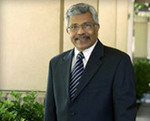
Pastor Mathew holds three graduate degrees in theology from Central and Westminster theological seminaries (USA) and is the founder and former Senior Minister of Grace Valley Christian Center. Originally a scientist from India, he is also a former professor