
The Clear Choice: Jesus or Barabbas
Matthew 27:11-26P. G. Mathew | Sunday, October 13, 1996
Copyright © 1996, P. G. Mathew
In a few days we will elect the president of the United States who will lead us into the third millennium of the Christian era. If we look carefully at the two major candidates and the philosophies, values and outlooks that they represent, we realize there is a clear choice. The person and the philosophies we choose will determine our destiny as a nation. Similarly, in this passage of Scripture we are introduced to two men, Jesus Barabbas and Jesus Christ, who represent a clear choice as far as our spiritual destiny is concerned. Each represents a different kingdom and a different way of entering that kingdom. Jesus Barabbas represents the kingdom of this world, meaning trying to find salvation in this world. This kingdom is entered through human efforts, specifically through the use of human power, including violence. Jesus Christ represents the kingdom of God which we enter in meekness through faith. We must realize that there are no other alternatives for our spiritual destiny. Every person who ever lives will either choose the one called Barabbas–the kingdom of this world–or the one called Christ–the kingdom of God.
Who Is Jesus Barabbas?
Who, then, is this character, Jesus Barabbas, who appears very briefly in the gospels? Barabbas is a patronym, a family name, like the patronymn of Peter, who was known as Simon Bar-Jonah. Simon was Peter’s first name and Bar-Jonah was his family name or patronym. Barabbas is a combination of two Aramaic words, bar, which means son, and abba, which means father. So Barabbas means “son of the father.” It may also be derived from the Aramaic words bar for son and rabbon for master or rabbi. If that is the case, Barabbas would mean “son of a rabbi.” In fact, some rabbis were also known as fathers in recognition of their teachings and education.
So we may conclude that it is possible that Barabbas was the son of a prominent rabbinic family in Jerusalem. He was probably well-educated and well-connected, especially politically. His full name was probably Jesus Barabbas, which appears in in the Syrian and Armenian versions of Matthew 27:16-17. A number of scholars, including William Barclay, D. A. Carson, Robert Gundry, and Klaas Schilder, seem to accept this reading. D. A. Carson wrote, “On the whole it is more likely that scribes deleted the name [Jesus from Jesus Barabbas] out of reverence for Jesus [Christ] than added it in order to set a startling if grotesque choice before the Jews,”1 and I agree with that reasoning. If Barabbas was also called Jesus, he had a very common name in the New Testament times. Jesus is the same as Joshua, and we read of another Jesus in Acts 13 in the account of a Jewish sorcerer Elymas whose family name was Bar-Jesus, meaning the son of Jesus.
Liberation through Jesus Barabbas
What else do we know about Barabbas? He was a political animal who believed in self-redemption, not in redemption through a messiah. The Bible calls him an insurrectionist, using a Greek word that means one who rises up against the existing authority and institutions–a seditionist, in other words. Barabbas had no interest in trusting in the coming Messiah. He wanted to become the savior of the Jewish people and attempted to liberate them from the yoke of Rome through political means. No doubt he joined the local liberation movement, whose modern counterparts would be organizations like the PLO, the Hamas and other freedom fighter groups.
To me this Jesus Barabbas, this dagger-carrying revolutionary, was the forerunner of the modern liberation theology movement which attempts to obtain its piece of the pie by the use of power, violence, and similar means, not by the practice of humility and faith in the gospel of Jesus Christ. Like liberation theologians who advocate the Marxist strategy of obtaining salvation, Barabbas wanted to overthrow existing institutions and take political power immediately. Eventually Barabbas and others did take part in an insurrection in Jerusalem against the Roman authority, but their rebellion was suppressed. Barabbas and his comrades were arrested by the Romans, tried, and and condemned to be crucified.
What else do we know about Barabbas? He is called a murderer in Mark 15:7, Luke 23:19, and Acts 3:14, which is not surprising. Liberation theology also believes in murder if it results in obtaining power now. Barabbas was also called a robber in John 18:14. According to Josephus the word used for robber, lestes, refers to members of the nationalist movement called Zealots, who supported themselves by robbery. Barabbas may have been a member of that movement. The two thieves who were crucified with Jesus Christ might also have been members of that movement. Why do we think that? At that time robbery was not a capital offense, and yet these two thieves were sentenced to be crucified. So we may well conclude that the thieves were also insurrectionists, murderers, and members of the movement led by Jesus Barabbas, the Zealot and patriotic freedom fighter.
In Matthew 27:16 Barabbas was described as notorious, but this word really means famous, popular, and notable. Barabbas was well-known in Jerusalem, and it seems he had a large following. He was even known to the Sanhedrin. Therefore, when Barabbas was sentenced to crucifixion, his fans–the Jerusalem crowd–and the Sanhedrin gathered early in the morning to demand his release.
Why did so many people side with Barabbas? They believed in this world, not in the world to come. They believed in having political power now. They believed in materialism and self-redemption. They did not believe the prophets and the promises of God. No, they wanted to take matters into their own hands, leaning onto their own understanding and saving themselves by whatever means. They wanted to wage guerrilla warfare. Their slogan was, “Power now! Fame now! Position now! Wealth now! Dignity now!”
While I was traveling through South India several years ago, I saw this slogan scrawled on a wall: “Salvation is through the barrel of a gun.” Those who wrote it, in other words, would say, “We do not wait and believe. We refuse to be humble, gentle and meek. We refuse to endure. We are no longer hoping for pie-in-the-sky-by-and-by. We are people of action who use raw power to obtain what we want.” I am sure Barabbas would say the same things.
Who Was Jesus Christ?
Who was Jesus Christ? First, he was a witness to the truth, as he told Pilate. And what was that truth? It was that God is, and that he is transcendent, meaning above and beyond all creation. It was that God is the creator of the world. It was that God is immanent, meaning he is involved in history as the Lord and Ruler of it. It was that all people are sinners under the wrath of God, and that God will punish such sinners for sinning against his majesty. It was that God is just and that he will rule in justice. It was that God is love and so he has a plan to save sinners. It was that he himself came into the world as the promised Messiah to save sinners, but not as a political king with soldiers and swords. It was that Jesus Christ is the exact opposite of Jesus Barabbas in that regard. It was that Jesus is the Son of God, the Son of the Father, the Son of David, who came to reveal the kingdom of God–a kingdom characterized by righteousness. It was that Jesus came to save sinners by suffering the wrath of God in their stead and on their behalf, to give his life a ransom in place of many, as he said in Matthew 20:28.
Unlike Jesus Barabbas, Jesus Christ refused to use raw political power to destroy existing institutions. He told Pilate his kingdom is not of this world. His mission was to save his people from their sins, from their guilt, from death, from the dominion of Satan, and from hell. Jesus came to liberate his people from slavery to sin, not from slavery to human institutions. In Matthew 1:21 we read, “You are to give him the name Jesus, because he will save his people from their sins.” And why can Jesus Christ alone save sinners? He can do so because he was not just a man, but he is also truly God. He was perfect man and perfect God–God incarnate.
Liberation through Jesus Christ
Jesus Christ came to testify to the truth that repentance and forgiveness of sins may be proclaimed on the basis of his work alone, especially on the basis of his violent death on the cross. So he went about preaching, “Repent and believe. The kingdom of God is at hand. Put your faith in me. Come unto me and I will give you rest and liberation. I am gentle and meek. Trust me, and be saved, from sin, Satan, death and hell. Be saved from the wrath of God that is coming upon every sinner.” Jesus came as the Lamb of God who takes away the sin of the world.
Like Barabbas, Jesus Christ had followers whom he instructed how to behave. But we must see the great contrast between the instruction of Jesus Christ and that of what Barabbas would give. In Matthew 5:2-10 we read: “Blessed are the poor in spirit, for theirs is the kingdom of heaven. Blessed are those who mourn, for they will be comforted. Blessed are the meek, for they will inherit the earth. Blessed are those who hunger and thirst for righteousness, for they will be filled. Blessed are the merciful, for they will be shown mercy. Blessed are the pure in heart, for they will see God. Blessed are the peacemakers, for they will be called sons of God. Blessed are those who are persecuted because of righteousness, for theirs is the kingdom of heaven.” What a tremendous difference between the ideas of violence and political force advocated by Jesus Barabbas and the words Jesus Christ!
The Crowd Responds to Jesus
But the Jerusalem crowd that gathered that day before the Sabbath did not want a humble Jesus. They wanted a Jesus who would use raw power to give them political salvation. We see this problem today even among evangelicals who think that they should get a piece of the pie also. They engage in tremendous political action, but such activities will not bring salvation.
The Sanhedrin, the religious authority, concocted some charges against Jesus Christ. They were liars, but they came up with three political charges which they thought would sound very relevant before Pilate. What were they? We read about them in Luke 23:2. First they said, “We have found this man subverting our nation,” although Jesus Christ was not an insurrectionist like Barabbas. Then they claimed, “He opposes payment of taxes to Caesar,” which again was a lie, as we read in Matthew 22, Mark 12 and Luke 20. Finally they said Jesus claimed to be Christ, a king, who would set himself up in opposition to the existing power of Rome.
These charges were merely trumped up lies. The last charge, that Jesus is the Christ, a king, is true in that Jesus is the Messiah who introduced the spiritual kingdom of God, the kingdom of righteousness, into this world. But Jesus was not a political king, an earthly king, as he himself told Pilate: “My kingdom is not of this world.” In fact, Jesus argued with Pilate that if he were an earthly king, his disciples would have used power to prevent him from being arrested and delivered unto Pilate. But as the humble Savior and Messiah, Jesus Christ did not use soldiers or swords to enforce his kingship.
Who Was Pilate?
Who was this judge, Pilate? He was the fifth procurator of the district of Judea and Samaria. He was called a prefect, and in 1971 an inscription was discovered in Caesarea which speaks about Pilate as the prefect of Judea and Samaria. As governor, Pilate was directly responsible to Emperor Tiberius, not to the Roman senate. Pilate ruled from A.D. 26-36, and although his headquarters were in Caesarea, during feast times he would come to Jerusalem to judge and oversee business.
Pilate hated the Jews and they hated him. He demonstrated his attitude toward the Jews when he dared to bring the Roman standard into Jerusalem. A Roman standard was a pole with a Roman eagle or the image of the reigning emperor upon it on top. Bringing the standard into Jerusalem, something no other procurator had ever done, showed utter disregard for the Jewish antipathy toward graven images. Additionally, Pilate built an aqueduct to bring water into Jerusalem during his rule. This was a beneficent act, but he financed the construction with money from the treasury of the Jewish temple, and therefore, the Jews hated him for that also.
Pilate was a cruel person who killed many people, as we are told in Luke 13:1. “Now there were some present at that time who told Jesus about the Galileans whose blood Pilate had mixed with their sacrifices.” History tells us that he later killed a number of Samaritans. Because of that he was finally removed from office and sent to Rome by his immediate superior, Vitellius, the legate of Syria, to answer to the emperor.
Jesus Christ Comes before Pilate
Jesus was brought by the Sanhedrin to Pilate and three false charges were filed against him. In his capacity as magistrate, Pilate was to hear the charges, question the defendant, hear his defense, and deliberate with his advisers. After deliberation, Pilate was to deliver his verdict and ensure that it would be carried out promptly.
This was the normal procedure, but we get the impression from the scriptural accounts of this trial that Pilate was not very interested in dealing with Jesus. In fact, he tried to avoid getting involved by telling the Jews, “Take him yourselves and judge him by your own law” (John 18:31), but the Jews had already done that. They had sentenced Jesus to death, and because only the Roman authorities had power to execute someone, they brought Jesus to Pilate.
Pilate was still reluctant to deal with Jesus. When he learned that Jesus was from Galilee, he sent him over to Herod Antipas, the playboy ruler who was also in Jerusalem at that time to celebrate the Passover. Because Galilee was under Herod’s jurisdiction, Pilate could send Jesus to him.
What did Herod do with Jesus? He was happy to see him because, as we read in Luke 23:8, “for a long time he had been wanting to see him. From what he had heard about him, he hoped to see him perform some miracle.” Herod was interested in Jesus and asked him many questions, but Jesus did not answer any of them. So Herod eventually sent Jesus back to Pilate without charging him with anything.
The Charge: Are You A King?
And so now Pilate asks Jesus a question: “Are you a king?” This was the most serious charge against Jesus, that he was setting himself up as a king in opposition to the existing authority of Rome and the authority of the emperor, Tiberius Caesar. And Jesus replied, Su legeis . Now, the NIV translates that “It is as you say,” but it really means “You say that.” In other words, Jesus was telling Pilate that yes, there was an element of truth in the charge, but Pilate must understand that Jesus is a king in a qualified sense of the term. In the book of John we see him explaining further to Pilate, “My kingdom is not of this world . . . I have come to this world to testify to the truth” (John 36-37).
Now, Pilate was a man who was familiar with politics and political power. When he looked at Jesus he knew right away that Jesus was not a seditionist or revolutionary. But although Jesus was meek and gentle, it was certainly true, as he told Pilate, that in one sense he is a king and a messiah. He was not a king in the sense he was charged, but he was a king in a spiritual sense of the term.
Pilate questioned Jesus closely again and again. Jesus told him, “I came to testify to the truth.” What was that truth? As I already said, that truth is that God is, that God is holy and just, that God is the Creator and sovereign Ruler of all, that God is the judge who will judge sinners, and that God is love and has a plan to save sinners who trust in Jesus, the Son of God, the Savior of the world.
The Innocence of Jesus
Pilate was a political animal who had no interest in spiritual salvation. He felt the power of Jesus personally, and heard the gospel from the very lips of Jesus, the eternal Judge of all that is, but what really mattered to Pilate was political power and continuing in his position. Yet, even though he had no interest in spiritual things, Pilate was completely convinced that Jesus Christ was innocent. Several times we read in the gospels Pilate’s words, “I find nothing in him.” Over and over again he declared, “I find nothing in him.” To Pilate Jesus was innocent.
So after Pilate examined Jesus, he declared to the Sanhedrin and to the crowd that Jesus Christ was innocent of the crimes they charged him with. But even though Pilate was convinced of Jesus’ innocence, Pilate was a coward. His fear of the crowd made him an unrighteous judge. He should have acquitted Jesus and faced the opposition of the Sanhedrin, the crowd and the world. But he was interested in his political survival, and was not ready to abandon his power for the sake of judging righteously.
His wife, Claudia Procula, interrupted the judgment procedure with a note regarding a dream she had that day. What did she tell her husband? “Don’t have anything to do with that innocent man, for I have suffered a great deal today in a dream because of him” (Matt. 27:19). Like her husband, Claudia proclaimed that Jesus was righteous. Thus, she was warning him to be careful and not to have anything to do with Jesus. Why? He is righteous.
Pilate’s Strategy
At this point in the trial I am sure that Pilate’s conscience was bothering him severely. Pilate knew that Jesus was innocent. He knew that the Jews handed Jesus over to him because they were jealous of Jesus’ fame, popularity, miraculous power, and moral purity.
Pilate had also experienced a personal encounter with Jesus, as I said before, in which Jesus, the Savior of the world, spoke the truth, the gospel, to Pilate. But Pilate would not repent and do what was right. He decided to try to punish Jesus lightly and release him, hoping thus to satisfy the Sanhedrin by meeting them halfway. He was not interested in justice. No, he wanted a win-win situation. So he proposed pardoning and freeing Jesus. There was a custom, it seems, that every Passover the crowd was given the privilege of choosing a convicted criminal to be freed. Pilate seized upon this custom and wanted to apply it to Jesus.
In the Roman world there were two kinds of amnesty. Abolitio meant freeing a prisoner before he was condemned, and indulgentia meant that a criminal could be freed after he was condemned. Pilate was trying to free Jesus before condemnation, abolitio, by taking advantage of the Passover custom. However, the Jerusalem crowd was not for Jesus Christ. Believing the propaganda of the Sanhedrin against Jesus Christ, the crowd instead asked for the release of Jesus Barabbas, the revolutionary. “Give us Barabbas!” they shouted again and again.
Pilate’s Strategy Fails
As the crowd shouted, Pilate’s hopes were dashed. In the gospel accounts this magistrate of Rome appears to be pitiful, helpless, and full of fear of the people. The people continued to pressure and threaten him. In John 19:12 we read, “From then on Pilate tried to set Jesus free, but the Jews kept shouting” –and this was their threat– “‘If you let this man go, you are no friend of Caesar. Anyone who claims to be a king opposes Caesar.'” In other words, the crowd was telling Pilate it was his duty to destroy this man who claimed to be king. But Pilate told the crowd he found no fault in Jesus. “‘Why? What crime has he committed?’ asked Pilate.” And notice the emotive response: “They shouted the louder” (Matt. 26:23). As we see even today, this crowd was not interested in reasoning or debating the issues. Everything was emotional and feeling-centered. They had nothing to do with truth. They wanted to manipulate the issue to their own advantage.
So Pilate, the magistrate of Rome, was afraid of the mob. If he released Jesus Christ the king, then the crowd would complain to Tiberius Caesar and Pilate would be punished. The rubber had touched the road. Pilate had to choose between self-interest and justice for Jesus, and he chose self-interest. He decided to retain his position and power at the expense of the innocent Jesus.
In Matthew 27:22 we see the pathos and the pitiable condition of this powerful magistrate: “‘What shall I do, then, with Jesus who is called Christ?’ Pilate asked.” He probably stated it that way to distinguish Jesus Christ from Jesus Barabbas. But what was Pilate doing? He was displaying his weakness and cowardice by asking the crowd’s counsel. Like today’s politicians, he was using opinion polls to see which way the wind was blowing. And he perceived that the wind was blowing against Jesus Christ and in favor of Jesus Barabbas.
Pilate Concedes to the Crowd
Pilate decided to satisfy the crowd, as we read in Mark 15:15. Release Barabbas, the crowd shouted. What reasons would this crowd give for their request? Oh, Barabbas is one of us. Barabbas believes in this world and in power and liberation now. He believes in bringing about political solutions by raw physical power. He believes in self-salvation and not in some kind of self-surrender. He doesn’t believe in this gentleness, this meekness, this grace, this faith and this pie-in-the-sky- by-and-by. Barabbas believes in pride, power, position, and fame in the here and now.
Then the question is, what should we do with Jesus called Christ? Let him be destroyed, crucified! Yes, that Jesus whom Judas handed over to the Sanhedrin, that Jesus the Sanhedrin handed over to Pilate, that Jesus Pilate sent to Herod and received back–Jesus Christ–would soon be handed over by Pilate to the soldiers to be crucified.
But let me tell you, no one handed Jesus over to be crucified on his own. We are told in Acts 2:23 that it was God who handed him over according to his set purpose and foreknowledge to be crucified. Jesus himself handed himself over to be crucified.
The Choice of the Crowd
What happened next? Pilate washed his hands with a little water and declared himself not guilty. The Sanhedrin also did not feel guilty. And what did the crowd say? “Let his blood be on us and on our children!” Why did they say that? They were convinced that by destroying Jesus, they were doing a service to God. To them, this was righteousness which they and their children will be blessed by doing. So, in essence, the crowd was saying: ‘We exculpate you, Pilate. Have a good conscience. We are doing the right thing. Ignore any pangs of conscience you might feel, Pilate. Pilate, we and our children are going to be blessed by doing this. Don’t worry, Pilate. Everything will be all right. Just destroy Jesus and everything will be all right.’ Now, ironically, that last statement is true, isn’t it? Everything can only be all right by the destruction of Jesus.
This crowd had a clear choice. They could choose salvation by self-interest, violence, and exercise of power, or salvation by faith. They could choose Jesus Barabbas or Jesus Christ, and we are told they all chose Jesus Barabbas. Now, this is always the truth. I am using Barabbas as a metaphor for any choice other than Jesus Christ. Even today the vast majority of people choose Jesus Barabbas, meaning they choose salvation by any other means than by faith in Jesus Christ. They want salvation by exercise of power. They say, Let’s get a piece of the action by hook or by crook–now! This transcendent thing called the kingdom of God is irrelevant. This salvation from sin, Satan, death, hell, and the wrath of God–forget about it! Forget about this entrance into heaven, this communion with God, this righteousness of God, and this peace of God that passes all human understanding that you are talking about. I value money, power, and position, and I want it now!
Therefore, such people would say, “We believe in Jesus Barabbas. We affirm materialism, this world and the kingdom of this age. We affirm this life only, and so we want salvation and power now.” These people chose Barabbas. They spared him. And they went and knocked at his cell and told him, “You are saved at the expense of this Jesus called Christ.”
Barabbas Is Released
In his commentary on the gospel of John, Dr. James M. Boice quotes Dr. Barnhouse’s description of Barabbas’s reaction:
The Roman soldiery had stopped the riot and had taken Barabbas. His blood-guiltiness was established. He was flung in his cell, there to wait the moment of his death. A man who is to be hanged has difficulty in keeping his hand away from his throat where the rope is soon to choke him. I have been told by a chaplain in a prison where men are executed in a gas chamber that the condemned practice long breathing, and sometimes will hold their breath until it seems that their eyes will pop from their sockets. They know that they are going to be put into a gas chamber and that they will hear a little hissing sound of incoming death, and that the breath they are now forcing into their lungs will be the last that they shall ever know. They will hold on and on, straining at the thongs that tie them to their chair, until they are forced by the inexorable law of breathing to exhale the last breath that contained pure oxygen and take in the death that floats around them.
Barabbas must have looked at the palms of his hands and wondered how it would feel to have the nails ripping through the flesh. He must have remembered scenes of crucifixion death, and the slow agony of the victims who suffered at times for a day or two before merciful death came to release them. He must have awakened with a start if he heard any hammering in the jail, and his mind must have anticipated the sound of the clanging hammers that would bring death near to him. And then, in his prison, he heard the vague murmuring of the crowd that roared outside like the murmur of a troubled sea. He thinks he hears his own name. He can tell that there are angry cries, and fear rises in his heart. Then he hears the sound of a key in the lock, and a jailer comes to him and releases him from the chain that is wound around him, for the Bible tells that he was bound. He must have thought that his time had come, but the jailer takes him to the door and tells him that he is free.2
Jesus Barabbas was saved at the expense of Jesus Christ. I do not believe that he received Jesus Christ as Lord, although some people would say he did. But the truth is, Barabbas knew what substitutionary atonement was in a physical sense. He was spared by the physical death of Jesus Christ.
We Have A Clear Choice
Let me ask you: Whom are you choosing, Jesus Barabbas, a political savior, or Jesus Christ, the true Savior of the world, the one who saves you from sin, Satan, hell, death? Let me assure you, in the final analysis, salvation by Jesus Barabbas can only give you emptiness.
Jesus Barabbas and his counterparts of today cannot save us because any salvation found in this world cannot cleanse our conscience. Only the blood of Jesus Christ alone can cleanse our consciences from guilt. We are told “if we confess our sins, he is faithful and just and will forgive us our sins and purify us from all unrighteousness.” We are also told by St. John, “If we walk in the light, as he is in the light, we have fellowship with one another, and the blood of Jesus his Son purifies us from all sin” (1 John 1:9, 7). Jesus Christ is the true Savior. His name is Jesus, “because he will save his people from their sins” (Matt. 1:21).
Jesus Barabbas was saved by Jesus, at least physically. And only Barabbas can say, “Jesus physically died in my place.” Barabbas understood something of substitutionary atonement, at least in a physical sense. But one day Jesus Christ is coming and Pilate will judged by him. Jesus Christ is the Judge of all the earth, and he said he is coming again, as we read in Matthew 26:64: “‘Yes, it is as you say,’ Jesus replied. ‘But I say to all of you: In the future you will see the Son of Man sitting at the right hand of the Mighty One and coming on the clouds of heaven.'”
So Pilate will be judged by Jesus. The Sanhedrin will be judged by him. The crowd will be judged by him. Jesus Barabbas will be judged by him. Every sinner who looks to false saviors and self-redemption will be judged by him. Why? Every sinner who fails to confess Jesus Christ is already condemned, the Bible says.
How Can We Be Saved?
Now our question ought to be, then, how can we be truly saved? Praise God, there is an answer! We must abandon faith in Jesus Barabbas and in all false messiahs–whether it is materialism or false religion, liberation theology or political action. We must abandon faith in self-redemption, salvation by works and salvation by political action. Abandon it all! We must believe on the Lord Jesus Christ and then we shall be saved. And if you do not know what it means to believe, think of how Jesus Barabbas believed when they said, “You are free,” and he was free.
In Matthew 20:28 we read a fascinating verse: “Just as the Son of Man did not come to be served, but to serve, and to give his life as a ransom for many.” The word “for” there means in place of, instead of. When Jesus Christ died on the cross, he experienced the wrath of God for us. The moment we believe in him, we are saved and cleansed from all sins, brought into communion with God and granted righteousness. When that happens, we will understand what the peace of God and liberation from sin, death, Satan, and hell is all about. And we will begin to rejoice with joy unspeakable and full of glory.
Are you still not convinced about the gospel? Are you turning back, thinking maybe Jesus Barabbas will save or something else–money, beauty, power, position–will save you? Let me assure you, nothing but Jesus Christ alone will save, and soon you will die and face him who is the Judge of all the earth. We are not making much progress because we are not thoroughly convinced that Jesus Christ alone is the Savior of the world. We are still thinking that maybe sex will save us, or pleasure or fame.
Did you hear of the man who just won the Nobel prize in economics? I am sure he received notice of this honor, but within a few days of hearing of his prize, he died. Now, from the world’s point of view, he died saved, because he had received such grand recognition for his life’s work. But he will be raised up too, and will be judged, not on his economic knowledge but on his relationship to Jesus Christ.
Think about it. What is the Jesus Barabbas that you are looking at and hoping in? If there is one, I urge you to abandon it completely and totally. Be convinced in the depth of your being that Jesus Christ alone is the Savior. Yes, you must make money so that you can eat and share with those in need. But don’t look for salvation in money, or in anything else in the world.
May God the Holy Spirit open your eyes today that you may see Jesus Christ, who came to witness to the truth, and may you put your trust in him alone for your eternal salvation.
1D. A. Carson, Matthew, in vol. 8 of The Expositor’s Bible Commentary, edited by Frank E. Gaebelein, (Grand Rapids: Zondervan Publishing House, 1984), 574.
2Donald Grey Barnhouse, God’s Remedy, vol. 3 of Expositions of the Epistle to the Romans, (Grand Rapids: Eerdmans, 1954) 376-78, as quoted by James Montgomery Boice, The Gospel of John: An Expositional Commentary, (Grand Rapids: Zondervan Corporation, 1985), 1302.
Thank you for reading. If you found this content useful or encouraging, let us know by sending an email to gvcc@gracevalley.org.
Join our mailing list for more Biblical teaching from Reverend P.G. Mathew.
About the Speaker
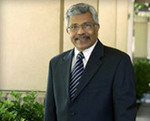
Pastor Mathew holds three graduate degrees in theology from Central and Westminster theological seminaries (USA) and is the founder and former Senior Minister of Grace Valley Christian Center. Originally a scientist from India, he is also a former professor