
Prayer, Part 1
P. G. Mathew | Saturday, June 10, 1995Copyright © 1995, P. G. Mathew
Language [Japanese] [Spanish]
Our subject this morning is Christian prayer. It is not just prayer, but Christian prayer. In Luke 11, we read, “One day Jesus was praying in a certain place. When he finished, one of his disciples said to him, ‘Lord, teach us to pray, just as John taught his disciples.’” It is our prayer that we will learn how to pray and what to pray; how to pray effectively; and that we will have learned these things from the teachings of Jesus Christ himself in the Holy Scriptures. Now, when we speak about prayer, we are not speaking about praying to creatures. This is what most of the people in the world do. If you travel to any part of the world, you will notice that people are all praying. They all are worshiping, but most of these people worship creatures. They pray to the sun; they pray to the moon; they pray to the trees; they pray to the storm; they pray to the saints. Such prayer, according to the Bible, is idolatry. Christian prayer is prayed by people who are true Christians, who have been born of God and given, not only forgiveness of sins, but also the divine nature. These are true Christians in whom the Holy Spirit dwells. For Christians, prayer ought to be as natural as the crying or breathing of a newborn baby. So let us consider the following points about true, Christian prayer.
- Prayer is conversation with the infinite, personal, triune God. Prayer is fellowship with this God. Prayer is communion, for which we are created, with this God. We are created to live a life in relationship with, in fellowship with, in communion with the one true and living God, who exists in three Persons. And this means you cannot pray and sleep at the same time. Normally, prayer is speech, articulation, conversation. I wish that I could pray while sleeping, but it doesn’t seem to work. Biblically, then, prayer is conversation with infinite Personality, the God of the Holy Scriptures, the God who created the universe and rules the universe.
- Through our prayer God’s will is done. There are people who ask: “Why should we pray when we know that God has foreordained all things? Whatever is coming to pass is coming to pass because God has ordained it, so what difference does it make whether you pray to God or not?” Well, that’s a foolish question, but the answer is that the God who foreordained all things also foreordained the means by which his foreordained ends may be accomplished.What does this mean? For instance, God saves sinners. However, he also ordained means by which a sinner may be saved, and that is through human beings preaching the gospel of Jesus Christ. So if someone asks, “Why should I witness? Why should I preach the gospel? God is great and God is big and God is absolutely sovereign. He has foreordained all things and he will save all people whom he has predestined to be saved,” we say, yes, he will save all people, but he saves through the means which he himself has foreordained. In the same way, God accomplishes his foreordained ends by means of his foreordained prayers that we pray. So, then, prayer is extremely important. It is through our prayer God’s will is done.
- Prayer must be according to God’s revealed will, and we discover his revealed will in only one place, in the book that God has given us, in the Old and New Testaments. The will of God is revealed in the Bible. If the will of God can be compared to a circle, then all our prayers must be inside the circle, meaning in accordance with the revealed will of God. You cannot pray outside the circle of revelation.For instance, suppose I do not love my wife, though we’ve been married many years, and now I want to have another woman. I cannot pray this prayer: “O God, find me another woman. It’s been 35 years now.” Why? Such prayer falls outside of the revealed will of God. Prayer should be prayed in accordance with the will of God as revealed in the Holy Scriptures.In John 15:7 we read, “‘If you remain in me and my words remain in you, ask whatever you wish and it will be given you.’” Notice, then, prayer must be in accordance with the will of God revealed to us. In 1 John 5:14 St. John says this: “This is the confidence we have in approaching God: that if we ask anything according to his will he hears us.” You see, the scope of prayer is anything you want, but then there is a limitation to that scope, which is “according to his will,” the word of God. John continues, “And if we know that he hears us, whatever we ask” – that “whatever” is limited by God’s word – “we know that we have what we asked of him.” This is a great verse that gives us great confidence, that if we pray in accordance with God’s own promises, he will do what he has promised. Read 2 Samuel 7:25-26, where David prays in this manner: “‘O God, perform what you have promised.’” This, also, is a very good illustration of proper prayer, prayer in accordance with the will of God.
- Why is prayer is important? Prayer is important, first, because God has commanded us to pray. It is through our prayer God meets our need. Prayer is the ordained means of grace by which our needs are being met.Secondly, there is a devil who is opposed to every Christian. In 1 Peter 5, beginning with verse 8, St. Peter tells us, “Be self-controlled and alert. Your enemy, the devil, prowls around like a roaring lion, looking for someone to devour. Resist him, standing firm in the faith.” So another reason to pray is that there is a devil who is ever trying to defeat and devour us. Of course, this will not happen, because God loves us and is for us. God’s people will pray and they will receive divine power and illumination to resist the devil by the blood of Jesus Christ.Thirdly, Jesus Christ himself, God incarnate, the Son of God, always prayed. He would normally get up very early in the morning, go to a solitary place, and pray. We see him praying all through his life. We see him praying in the Garden of Gethsemane. We see him praying on the cross while he was dying. So, to Jesus, prayer was common, like breathing. He continually communed with his heavenly Father.Fourthly, the apostles prayed and taught us to pray. Especially when you read the book of Acts, you find the apostles praying continually. In Acts 6:4 Peter says, We must “give our attention to prayer and the ministry of the word.” They were taught well by our Lord and Savior Jesus Christ.
- God does not hear the prayers of pagans, of sinners. No sinner can ever approach the throne of God and pray to him. He will not be allowed to come into the presence of God and pray, simply because his sin separates him from God. The only people who can truly pray are people who are born again by the Holy Spirit, who are given the divine nature, whose sins have been put away once for all. They are the ones who will be allowed to come boldly to the throne of grace and commune with God and God will hear their prayers.But we have already noted that many people pray. What do we conclude in terms of all this piety that we notice among people around the world? We have to say they are not praying to the true God, to the infinite personal God who created the universe and rules the universe. They are not praying to the Father, Son and the Holy Spirit.
- Prayer is very, very difficult. It is a very difficult exercise. We can come to church easily. We can read the Bible easily. We can listen to sermons easily. We can do many, many things more easily than going to God and praying. Why? We are sinners, and there is a devil who opposes us. The devil hates it when we are on our knees and praying, not sleeping, to Almighty God. So the truth is, Christians, particularly in the economically most developed countries in the world do not pray much at all, because they don’t seem to have very many needs. Their needs are superficially covered up by economic prosperity, even though they have serious spiritual needs. They think that everything is all right, and therefore they don’t need to pray. They would rather read the newspaper. They would rather watch television very faithfully. This television is like a drug. If they don’t take it, they are upset. They will have withdrawal syndromes. So Christian people spend time doing everything else except praying. So let us acknowledge that prayer is extremely difficult. I am very glad that in this church people are coming at 6:30 in the morning to call upon the Lord and pray. That is a great commitment for those who are able to do so. When we pray, we know that we do so because the Holy Spirit has generated within us a great desire to pray. No one prays unless God produces and births in us such a desire to cry out to God and to commune with God.
- Prayer is normally addressed to God the Father. You could also address it to God the Son, and to God the Holy Spirit, but normally prayer is addressed to God the Father. In Matthew 6:9, in the prayer Jesus himself taught us, he said, “‘This, then, is how you should pray: Our Father, who art in heaven.’” So, prayer must be addressed to God the Father, who is the first person of the Holy Trinity.Now, God the Father is your Father, and so he loves to hear your prayers. He loves to see you. We shouldn’t think that God the Father is very stern and transcendent and different from us. But how in the world can we, as sinners, ever go to God the Father? We do so through Jesus Christ, but the truth is, it is God the Father who loved us from all eternity, and who planned our salvation. It is He who planned our access to him through Jesus Christ. Therefore, you need to understand that God the Father loves us very dearly as a Father loves his own children. We should understand that he delights in our coming and praying to him. He is more ready to answer our prayers than we are to pray. So keep that in mind, especially when you come to God the Father in prayer.
- Prayer is offered through Jesus Christ. Look at Hebrews 10, verses 19-20, 22. Prayer is offered to the Father through Jesus Christ. “Therefore, brothers, since we have confidence to enter the Most Holy Place by the blood of Jesus by a new and living way opened for us through the curtain, that is, his body…” It is on the basis of the atonement that Christ has made in behalf of us that we can come to the presence of God the Father. Access to God the Father comes to us through Jesus Christ through his mediation, through the blood of Jesus Christ, which he shed in behalf of us. In verse 22, we read, “Let us draw near to God with a sincere heart in full assurance of faith, having our hearts sprinkled to cleanse us from a guilty conscience and having our bodies washed with pure water.” Now this means, then, we must come to God through the work of Jesus Christ, through the blood of Jesus Christ. Jesus Christ said, “‘I am the way and the truth and the life. No one comes to the Father except through me.’” So through Jesus Christ we come to the Father.
We are also told to pray in the name of Jesus Christ, which means in his authority on the basis of his mediatorship. We don’t come to the Father based on our own righteousness. We come to the Father based on the redemptive work of Jesus Christ, based on the righteousness of Jesus Christ which he put into our account. So now we can come to God the Father, and God the Father accepts us because we come in Jesus Christ.
Finally, we must also notice that we come to Jesus Christ in the Holy Spirit. Read Ephesians 2:18 and Romans 8:15. God has given us the Spirit of adoption by whom we cry, “Abba, Father.” Prayer is offered to the Father through Jesus Christ in the Holy Spirit whom God has given us.
May we think about these things, and put them into practice, that we may enjoy this great privilege called prayer. Amen.
Thank you for reading. If you found this content useful or encouraging, let us know by sending an email to gvcc@gracevalley.org.
Join our mailing list for more Biblical teaching from Reverend P.G. Mathew.
About the Speaker
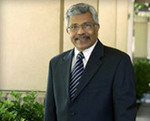
Pastor Mathew holds three graduate degrees in theology from Central and Westminster theological seminaries (USA) and is the founder and former Senior Minister of Grace Valley Christian Center. Originally a scientist from India, he is also a former professor